/

What is Coral?

サンゴとは

Not a rock. Not a plant. A living animal that builds reefs.

岩でも植物でもない。サンゴ礁を築く動物。

Corals are animals サンゴは動物である

Corals belong to the phylum Cnidaria, the same group as jellyfish and sea anemones. The basic unit of a coral is the polyp—a tiny sac-like animal typically only a few millimeters in diameter. Each polyp has a central mouth surrounded by tentacles armed with stinging cells called nematocysts.

サンゴは刺胞動物門(Cnidaria)に属する。クラゲやイソギンチャクと同じ仲間である。サンゴの基本単位は「ポリプ」と呼ばれる袋状の個体で、直径はわずか数ミリメートル。口の周囲には刺胞(nematocyst)を備えた触手がある。

Most reef-building corals are colonial—hundreds to millions of genetically identical polyps connected by living tissue called coenosarc. What appears to be a single "coral" is actually a colony of clones, each polyp contributing to the shared skeleton beneath.

造礁サンゴの多くは群体性である。数百から数百万の遺伝的に同一なポリプが、共肉(coenosarc)と呼ばれる生きた組織でつながっている。一つの「サンゴ」に見えるものは、実際には無数のクローンの集合体であり、それぞれのポリプが共有する骨格の形成に貢献している。

Day and night: Two faces of coral 昼と夜:サンゴの二つの顔

During the day, most coral polyps retract into their skeletons, appearing as textured stone. At night, they extend their tentacles to capture zooplankton drifting in the current. A night dive reveals an entirely different reef—polyps fully extended, feeding actively, the reef surface appearing fuzzy and alive. This heterotrophic feeding supplements the energy from symbiotic algae by 10–30%.

日中、多くのサンゴポリプは骨格内に引っ込み、表面はざらついた岩のように見える。夜になるとポリプは触手を伸ばし、潮流に乗って漂う動物プランクトンを捕食する。ナイトダイブでは全く異なるサンゴ礁が現れる—ポリプは完全に開き、活発に摂食し、サンゴ礁の表面は毛羽立って生きているように見える。この従属栄養的な摂食は、共生藻類からのエネルギーを10〜30%補完する。

Taxonomy: Phylum Cnidaria → Class Anthozoa → Order Scleractinia (stony corals). About 1,500 species of stony corals exist worldwide, with approximately 400 species found in Japanese waters—half the world's diversity concentrated along the Kuroshio Current.

分類: 刺胞動物門 → 花虫綱 → イシサンゴ目。世界に約1,500種のイシサンゴが存在し、日本近海には約400種が生息する。世界の多様性の半数が黒潮に沿って集中している。
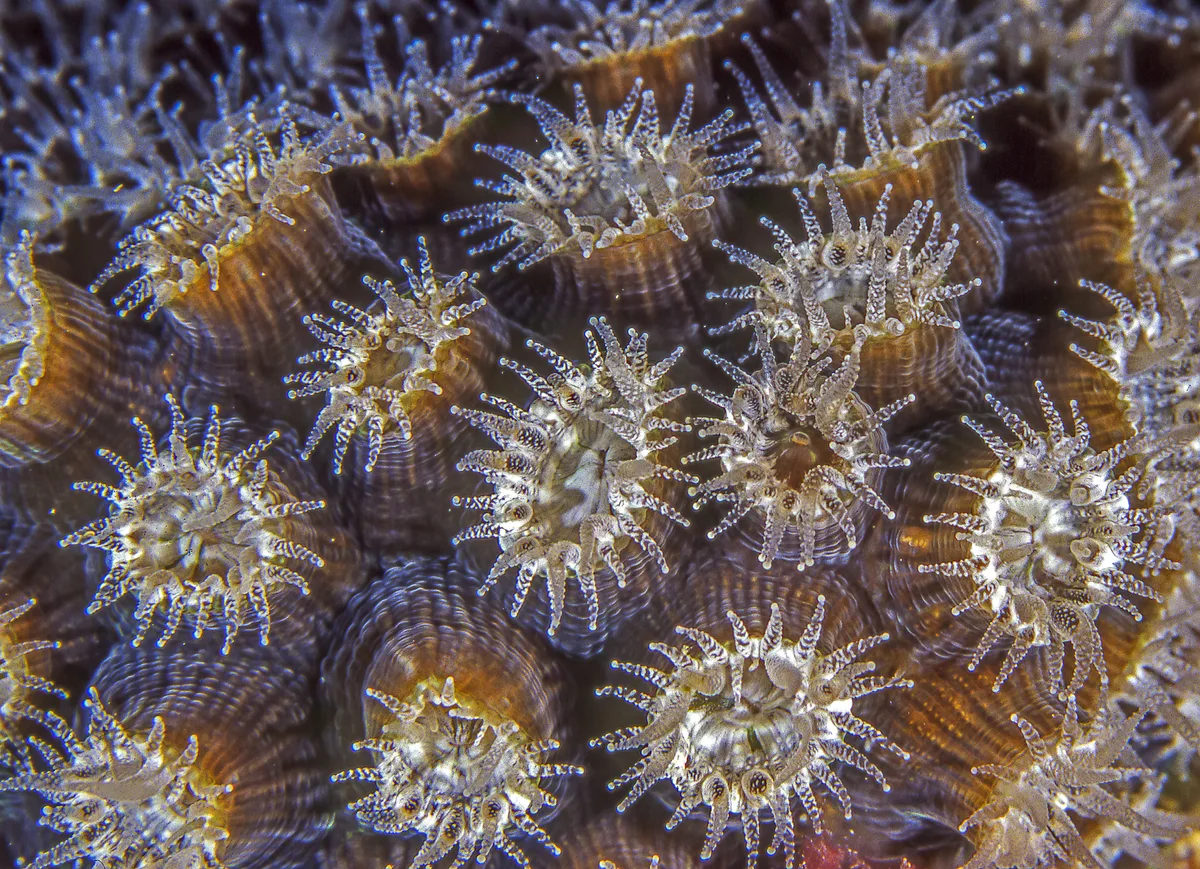
Coral polyps extended at night
Coral polyps fully extended at night, capturing zooplankton with their tentacles. The nematocyst batteries at tentacle tips are visible as small dots. 夜間に触手を伸展させたサンゴポリプ。触手先端の刺胞球が小さな点として見える。

Building skeletons 骨格を作る

Stony corals secrete calcium carbonate (aragonite) from the base of each polyp, creating a cup-shaped structure called a corallite. The process requires energy—calcification rates are 3× higher in light due to photosynthesis by symbiotic algae. Over years and generations, these accumulated skeletons form the massive limestone structures we recognize as coral reefs.

イシサンゴは各ポリプの基部から炭酸カルシウム(アラゴナイト)を分泌し、「個体骨格(corallite)」と呼ばれる杯状の構造を作る。この石灰化にはエネルギーが必要で、共生藻類の光合成により明条件下では石灰化速度が3倍になる。長い年月と世代を経て、蓄積した骨格がサンゴ礁という巨大な石灰岩構造を形成する。

Growth forms and rates 成長形態と成長速度

Coral colonies take on different shapes depending on species and environment. Growth rates vary dramatically by morphology:

サンゴ群体は種と環境によって異なる形態をとる。成長速度は形態によって大きく異なる:

Growth Form成長形態 Growth Rate成長速度 Examples代表種 Heat Vulnerability熱脆弱性
Branching枝状 5–30 cm/yr Acroporaミドリイシ属 High高い
Tabularテーブル状 3–10 cm/yr A. hyacinthusクシハダミドリイシ High高い
Massive塊状 0.3–1 cm/yr Poritesハマサンゴ属 Low低い
Encrusting被覆状 0.5–2 cm/yr Montiporaコモンサンゴ属 Medium中程度

Why branching corals bleach first 枝状サンゴが真っ先に白化する理由

The high heat vulnerability of branching corals like Acropora is not coincidental. Their high surface-area-to-volume ratio means heat penetrates tissue rapidly. Their thin tissue layer (1–2mm) offers little thermal buffering. Fast growth also requires high metabolic rates, making them more susceptible to oxidative stress when photosynthesis malfunctions under heat.

ミドリイシ属などの枝状サンゴの熱脆弱性には理由がある。高い表面積/体積比により、熱が組織に急速に浸透する。薄い組織層(1〜2mm)は熱緩衝能力に乏しい。また、速い成長には高い代謝率が必要であり、高温下で光合成が異常をきたすと酸化ストレスに弱い。

Time scales: A 1-meter massive Porites colony represents 100+ years of growth. Like tree rings, coral skeletons contain annual density bands that record past temperature and water chemistry—invaluable climate archives now threatened by ocean warming.

時間スケール: 直径1mのハマサンゴ塊は100年以上の成長を表す。年輪のように、サンゴ骨格には過去の水温や水質を記録した年輪状の密度帯がある。この貴重な気候アーカイブが、海洋温暖化により失われつつある。

Living through symbiosis 共生で生きる

Most reef-building corals host microscopic dinoflagellates of the family Symbiodiniaceae within their gastrodermal cells. Formerly grouped as a single genus "Symbiodinium," these algae were reclassified in 2018 into multiple genera reflecting their deep evolutionary divergence (LaJeunesse et al. 2018). A single square centimeter of coral tissue can contain up to 1 million of these cells.

造礁サンゴの多くは、胃層細胞内に共生藻類科(Symbiodiniaceae)の微細な渦鞭毛藻を共生させている。かつては「シンビオディニウム」という単一属にまとめられていたが、2018年の系統分類の改訂により、深い進化的分岐を反映した複数属に再分類された(LaJeunesse et al. 2018)。サンゴ組織1cm²あたり最大100万もの細胞を有する。

This relationship is remarkably efficient. Zooxanthellae use the coral's metabolic waste (CO₂ and nutrients) for photosynthesis. Up to 90% of photosynthetic products—glycerol, glucose, amino acids—are transferred to the host. This "tight recycling" of nutrients allows coral reefs to thrive in oligotrophic tropical waters that would otherwise be biological deserts.

この共生関係は驚くほど効率的である。褐虫藻はサンゴの代謝廃棄物(CO₂や栄養塩)を光合成に利用する。光合成産物—グリセロール、グルコース、アミノ酸—の最大90%が宿主に転送される。この栄養の「タイトなリサイクル」により、サンゴ礁は生物学的砂漠となりうる貧栄養の熱帯海域で繁栄できる。

Not all zooxanthellae are equal 褐虫藻はすべて同じではない

Different genera and species of Symbiodiniaceae have different thermal tolerances. Durusdinium (formerly Clade D) can tolerate temperatures 1–2°C higher than Cladocopium (Clade C), the most common type. However, heat-tolerant types typically transfer less photosynthate to the host—a trade-off between thermal tolerance and growth rate. Some corals can "shuffle" their symbiont communities toward more heat-tolerant types after bleaching events.

共生藻類科の異なる属・種は、異なる熱耐性を持つ。ドゥルスディニウム属(旧クレードD)は、最も一般的なクラドコピウム属(クレードC)より1〜2°C高い温度に耐えられる。しかし、耐熱性の高いタイプは一般に宿主への光合成産物の転送量が少ない—熱耐性と成長速度のトレードオフがある。白化イベント後、より耐熱性の高いタイプへと共生群集を「シャッフル」できるサンゴもいる。

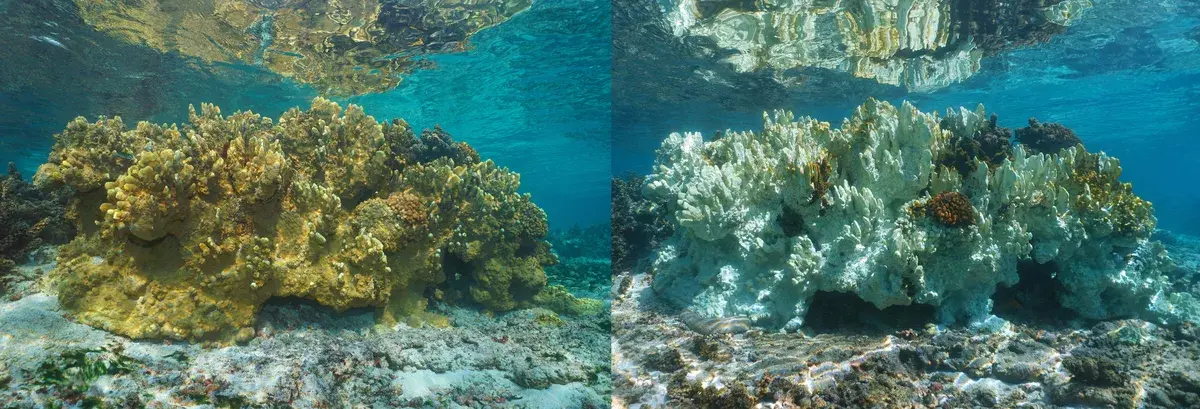
When symbiosis breaks down → bleaching. Heat stress causes oxidative damage in zooxanthellae, which then produce reactive oxygen species toxic to the host. The coral expels the algae as a stress response, losing both color and its primary energy source. For more: What is Bleaching?

共生が崩壊すると → 白化。 熱ストレスは褐虫藻に酸化損傷を引き起こし、宿主に有害な活性酸素種を生成させる。サンゴはストレス応答として藻類を放出し、色と主要なエネルギー源の両方を失う。詳しくは: 白化とは

The colors of healthy corals come from both zooxanthellae pigments (browns, yellows, greens from chlorophyll and accessory pigments) and fluorescent proteins produced by the coral itself. These coral-produced proteins (GFP-like proteins) create blues, purples, and pinks, and may serve as photoprotection or immune functions.

健康なサンゴの色は、褐虫藻の色素(クロロフィルや補助色素による茶色、黄色、緑色)とサンゴ自身が生産する蛍光タンパク質に由来する。これらのサンゴ由来タンパク質(GFP様タンパク質)は青、紫、ピンクを生み出し、光保護や免疫機能を担う可能性がある。

Coral bleaching comparison: healthy vs bleached
Left: Healthy coral with zooxanthellae. Right: The same reef 6 months later—bleached, with the white skeleton visible through the tissue. 左:褐虫藻を持つ健康なサンゴ。右:6ヶ月後に白化したサンゴ。白い骨格が組織を通して透けて見える。

Where corals live どこに住むか

Because reef-building corals depend on zooxanthellae for energy, they require specific conditions:

造礁サンゴは褐虫藻のエネルギーに依存するため、特定の条件を必要とする:

  • Temperature: 水温: 18–30°C (optimal 25–29°C). Below 18°C, tissue damage begins; below 14°C, mortality occurs within days. 18〜30°C(最適25〜29°C)。18°C以下で組織損傷が始まり、14°C以下では数日で死亡する。
  • Light: 光: Sufficient PAR for photosynthesis; typically less than 50m depth, though some species extend to 100m+. 光合成に必要な十分な光合成有効放射(PAR)、通常は水深50m未満だが、100m以深に生息する種もある。
  • Clarity: 透明度: Low turbidity for light penetration. Sedimentation smothers polyps and reduces calcification. 光が届くための低い濁度。堆積物はポリプを窒息させ、石灰化を阻害する。
  • Salinity: 塩分: Normal seawater (32–42‰). Heavy rainfall can cause localized bleaching from osmotic stress. 通常の海水塩分濃度(32〜42‰)。大雨は浸透圧ストレスにより局所的な白化を引き起こしうる。

Coral distribution in Japan 日本のサンゴ分布

Japan lies at the northern limit of coral reef distribution, shaped by the warm Kuroshio Current. A critical distinction exists between coral reefs and coral communities:

日本は世界のサンゴ分布の北限域にあたり、暖かい黒潮の影響を受ける。サンゴ礁サンゴ群集の区別が重要である:

  • Coral reefs: サンゴ礁: Self-built limestone structures where corals are the primary framework builders. Limited to Okinawa, Amami, and southern Kyushu (north to ~30°N). サンゴ自身が構築した石灰岩構造で、サンゴが主要な骨格形成者。沖縄、奄美、南九州に限定(北緯約30度まで)。
  • Coral communities: サンゴ群集: Corals growing on rocky substrate without building reef structures. Extend to Tateyama (Chiba, 35°N) on Pacific side, Tsushima/Iki on Sea of Japan side. 岩礁基盤上に成長するが礁構造を形成しない。太平洋側は館山(千葉、北緯35度)、日本海側は対馬・壱岐まで分布。

Japan hosts approximately 400 coral species—about half of the world's diversity. Key monitoring sites along this latitudinal gradient include Sekisei Lagoon (Japan's largest reef), Kerama, Manza, Sesoko, Amami, and Kushimoto (northernmost reef-building limit at 33.5°N).

日本近海には約400種のサンゴが生息する—世界の多様性の約半数である。この緯度勾配に沿った主要なモニタリング地点には、石西礁湖(日本最大のサンゴ礁)、慶良間、万座、瀬底、奄美、串本(北緯33.5度、造礁サンゴの北限)がある。

Northward expansion—with caveats: Coral distribution is shifting poleward at ~14 km/year (NIES). Species once confined to Okinawa now appear in Wakayama, Shizuoka, and Chiba. However, "range expansion" ≠ "ecosystem expansion." The complex ecological functions of coral reefs—fish assemblages, invertebrate diversity, carbonate production—may not follow. Winter cold snaps remain the limiting factor; a single week below 13°C can kill temperate corals (Yamashiro 2012).

北上—ただし注意が必要: サンゴの分布は年間約14kmのペースで北上している(国環研)。かつて沖縄にしかいなかった種が、和歌山、静岡、千葉で観察されるようになった。しかし、「分布拡大」≠「生態系拡大」である。サンゴ礁の複雑な生態系機能—魚類群集、無脊椎動物の多様性、炭酸塩生産—は追随しない可能性がある。冬季の寒波が依然として制限要因であり、13°C以下が1週間続くと温帯サンゴは死亡しうる(Yamashiro 2012)。

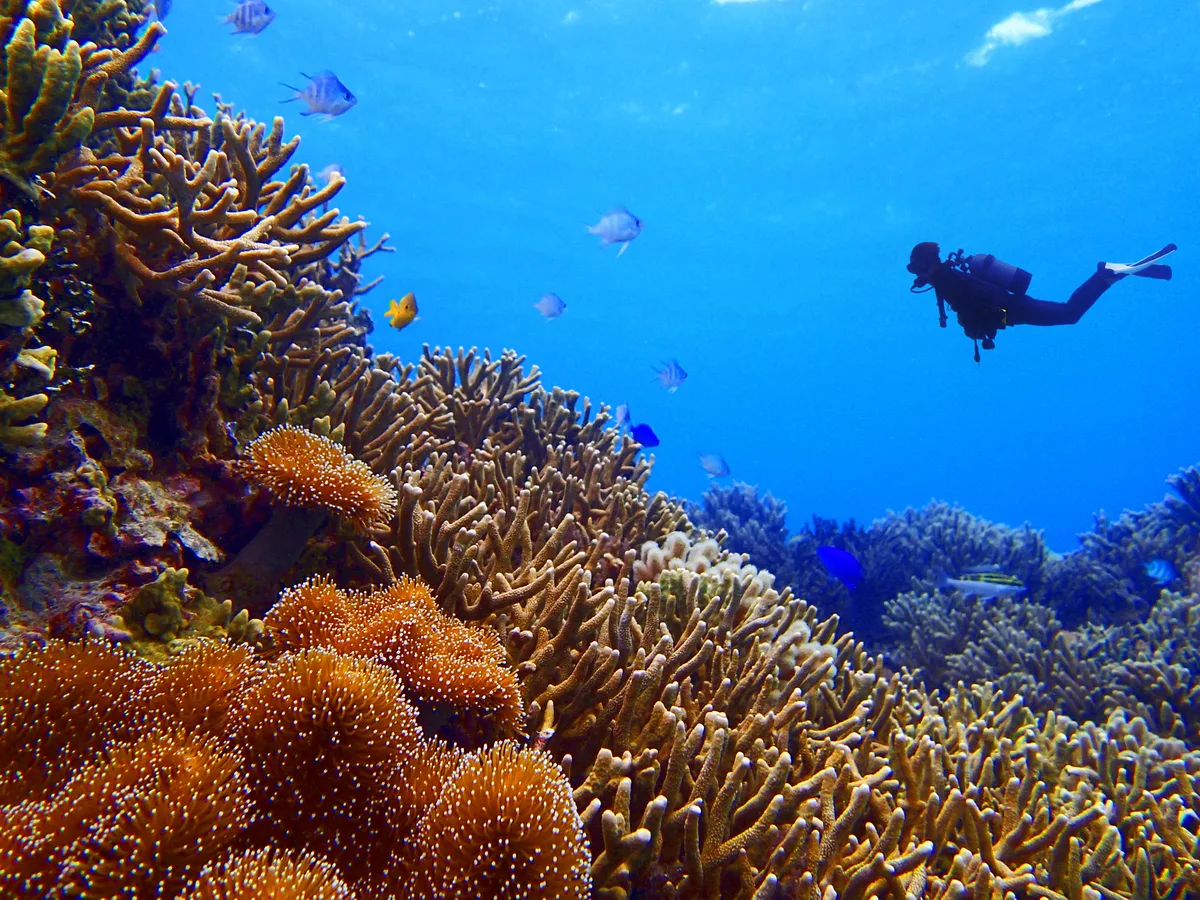
Coral reef ecosystem with diver
A healthy coral reef ecosystem with branching corals, sea anemones, and reef fish. 健康なサンゴ礁生態系。枝状サンゴ、イソギンチャク、魚類が共存する。

Key References 主要文献

  • LaJeunesse TC, et al. (2018). Systematic Revision of Symbiodiniaceae Highlights the Antiquity and Diversity of Coral Endosymbionts. Current Biology 28:2570-2580. doi:10.1016/j.cub.2018.07.008
  • Lough JM, Cantin NE. (2014). Perspectives on massive coral growth rates in a changing ocean. Biological Bulletin 226:187-202.
  • Nakabayashi A, et al. (2019). The potential role of temperate Japanese regions as refugia for the coral Acropora hyacinthus. Scientific Reports 9:1892. doi:10.1038/s41598-018-38333-5
  • Yamashiro H, et al. (2012). Effects of low water temperatures on the physiology of corals. Galaxea, Journal of Coral Reef Studies.
  • 国立環境研究所. 日本のサンゴの変化から世界が見える. 環境儀 No.53. nies.go.jp
  • Veron JEN. Corals of the World. coralsoftheworld.org