
Current Global SST Anomalies 現在の世界海面水温偏差
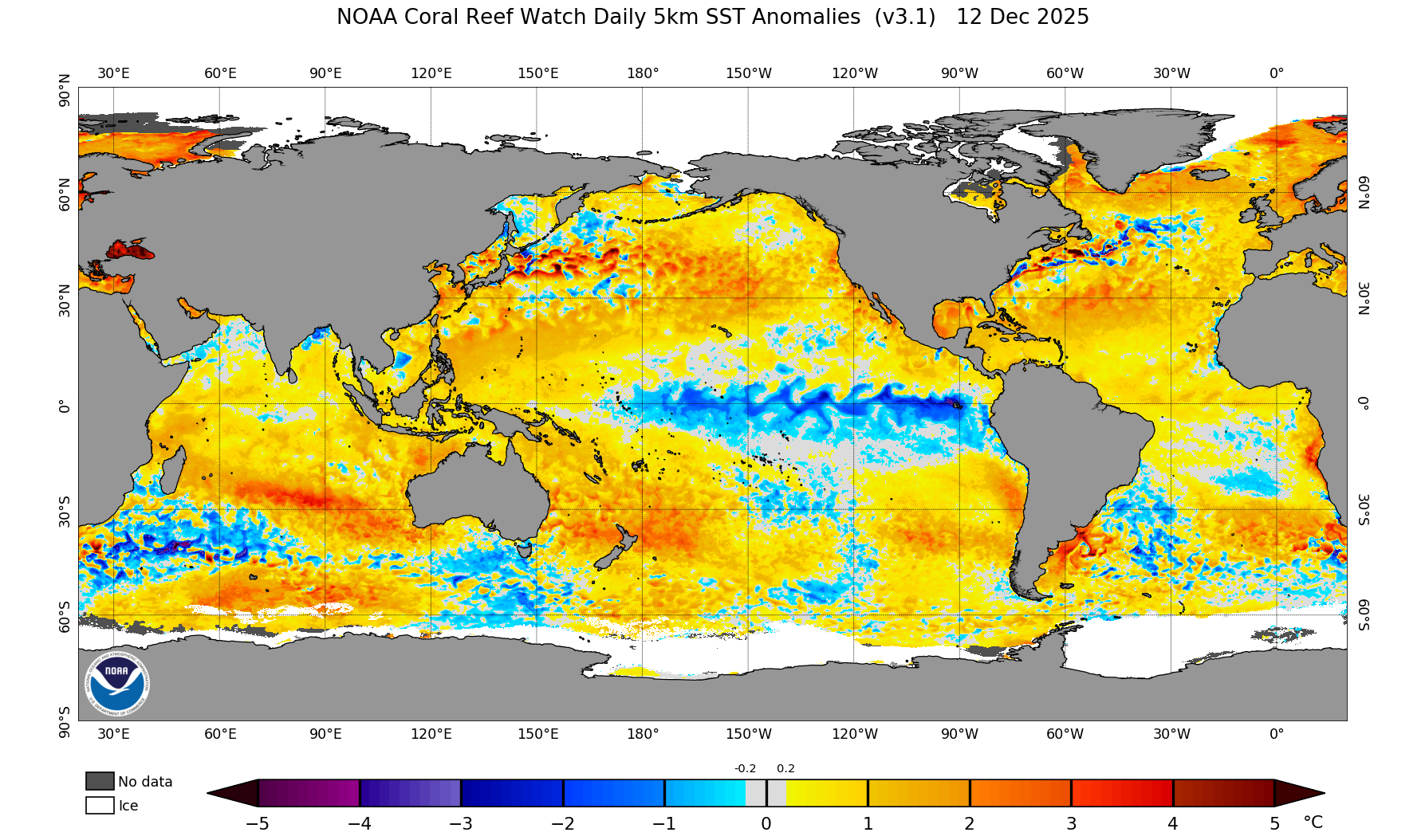
Source: NOAA Coral Reef Watch Daily 5km SST Anomalies. Blue = cooler than average, Red = warmer than average. 出典:NOAA Coral Reef Watch 日次5km SST偏差。青=平年より低温、赤=平年より高温。
Current ENSO Status 現在のENSO状態
Data: NOAA CPC. Red markers indicate years with documented mass bleaching events globally or in Japan. データ:NOAA CPC。赤いマーカーは世界または日本で大規模白化が記録された年。
How ENSO Affects Coral Reefs ENSOがサンゴ礁に与える影響
🔴 El Niño 🔴 エルニーニョ
Weakened trade winds allow warm water to spread eastward across the Pacific. Global average sea surface temperatures rise, triggering worldwide bleaching events.
貿易風が弱まり、暖水が太平洋を東へ広がる。全球の平均海面水温が上昇し、世界規模の白化イベントを引き起こす。
- 1998: First global bleaching (ONI +2.4)
- 1998年:初のグローバル白化(ONI +2.4)
- 2014-16: Third global bleaching (ONI +2.6)
- 2014-16年:第3回グローバル白化(ONI +2.6)
- 2023-24: Fourth global bleaching
- 2023-24年:第4回グローバル白化
🔵 La Niña — Also Dangerous 🔵 ラニーニャ — 西太平洋は危険
Counterintuitively, La Niña can be more dangerous for Japan and the western Pacific. Warm water piles up in the west, raising temperatures in the Coral Triangle, Great Barrier Reef, and Okinawa.
直感に反して、ラニーニャは日本や西太平洋にとってより危険な場合がある。暖水が西に集中し、コーラルトライアングル、グレートバリアリーフ、沖縄の水温が上昇する。
- West Pacific SST rises during La Niña
- ラニーニャ期は西太平洋のSST上昇
- Japan, GBR, Palau at elevated risk
- 日本、GBR、パラオのリスク増大
- 2007 Yaeyama bleaching during La Niña
- 2007年八重山白化はラニーニャ期
The Race Against Time: Recovery vs. Recurrence 時間との競争:回復と再発
One of the most critical—yet often overlooked—aspects of coral bleaching is the mismatch between recovery time and bleaching frequency. Coral reefs typically require 10–15 years to fully recover from severe bleaching events. Yet ENSO cycles now drive mass bleaching events roughly every 6 years on average globally. This arithmetic alone threatens reef persistence.
サンゴ白化において最も重要でありながら見落とされがちな側面の一つが、回復に必要な時間と白化の発生頻度のミスマッチである。サンゴ礁が大規模白化から完全に回復するには通常10〜15年を要する。しかしENSOサイクルは今や世界平均で約6年ごとに大規模白化を引き起こしている。この算術だけでもサンゴ礁の存続が危ぶまれる。
Recovery Time Needed
必要な回復時間
Actual Bleaching Interval
実際の白化間隔
⚠️ "Ecological Memory" — The Compounding Effect ⚠️「生態学的記憶」— 複合的影響
Hughes et al. (2018) documented that during back-to-back bleaching on the Great Barrier Reef (2016–2017), corals that survived the first event were more vulnerable to the second—not less. The 2017 bleaching pattern was heavily influenced by what happened in 2016. This "ecological memory" means cumulative damage accelerates faster than individual events would suggest.
Hughes et al. (2018) は、グレートバリアリーフでの連続白化(2016–2017年)において、最初のイベントを生き延びたサンゴが2回目に対してより脆弱であったことを記録した。2017年の白化パターンは2016年に起きたことに大きく影響されていた。この「生態学的記憶」は、累積的なダメージが個々のイベントの合計よりも速く進行することを意味する。
Japan's Bleaching Timeline: Shrinking Windows 日本の白化年表:短縮する回復期間
Note the acceleration: 1998→2007 (9 years), 2007→2016 (9 years), then 2016→2017 (consecutive), and 2017→2024 (7 years). The 2016 event was so severe that corals barely had time to stabilize before 2017 hit. Now, the 2024 event struck reefs that had only partially recovered from 2016–2017. 加速に注目:1998→2007(9年)、2007→2016(9年)、そして2016→2017(連続)、2017→2024(7年)。2016年のイベントが非常に深刻だったため、2017年が到来する前にサンゴが安定する時間がほとんどなかった。そして2024年のイベントは、2016–2017年からまだ部分的にしか回復していなかったサンゴ礁を襲った。
Beyond ENSO: The PDO Connection ENSOを超えて:PDO(太平洋十年規模振動)との関係
📊 What is the PDO? 📊 PDOとは何か?
The Pacific Decadal Oscillation (PDO) is a long-term climate pattern that shifts between warm and cool phases roughly every 20–30 years. Think of it as ENSO's slower, larger cousin. While ENSO operates on 2–7 year cycles, PDO sets the background "mode" that either amplifies or dampens ENSO's effects on coral reefs.
太平洋十年規模振動(PDO)は、約20〜30年ごとに暖かいフェーズと冷たいフェーズの間を移行する長期的な気候パターンである。ENSOの遅い、より大きな従兄弟と考えるとよい。ENSOが2〜7年のサイクルで動くのに対し、PDOはサンゴ礁に対するENSOの影響を増幅または減衰させる背景的な「モード」を設定する。
💡 Key Finding: Houk et al. (2020) 💡 重要な発見:Houk et al. (2020)
ENSO alone doesn't predict bleaching well. The combination of ENSO and PDO phase is far more predictive. Different combinations create different risk profiles across the Pacific—and importantly for Japan, what matters is not just whether El Niño or La Niña is occurring, but how they interact with the current PDO phase.
ENSOだけでは白化をうまく予測できない。ENSOとPDOフェーズの組み合わせがはるかに予測力が高い。異なる組み合わせが太平洋全体で異なるリスクプロファイルを生み出す——日本にとって重要なのは、エルニーニョやラニーニャが発生しているかどうかだけでなく、それらが現在のPDOフェーズとどう相互作用するかである。
Climate Mode Combinations: Risk Matrix for Japan 気候モードの組み合わせ:日本のリスクマトリックス
🔴 Positive PDO + La Niña 🔴 正のPDO + ラニーニャ
Highest risk for Japan. Warm water piles up in the western Pacific. SST peaks in Okinawa, Coral Triangle, GBR. Typhoon tracks may shift, reducing cooling.
日本にとって最高リスク。 暖水が西太平洋に集中。沖縄、コーラルトライアングル、GBRでSST上昇。台風の経路が変化し、冷却効果が減少する可能性。
🟠 Positive PDO + El Niño 🟠 正のPDO + エルニーニョ
Chlorophyll peaks. While SST may be less extreme in western Pacific, nutrient upwelling increases Crown-of-Thorns starfish (Acanthaster) outbreaks—a different threat to corals.
クロロフィル増加。 西太平洋のSSTはそれほど極端ではないかもしれないが、栄養塩の湧昇によりオニヒトデ(Acanthaster)の大発生リスク増加——サンゴへの別の脅威。
🟠 Negative PDO + El Niño 🟠 負のPDO + エルニーニョ
Global bleaching risk elevated. Eastern Pacific and Caribbean more affected. Western Pacific relatively buffered but not immune.
グローバルな白化リスク上昇。 東太平洋とカリブ海がより影響を受ける。西太平洋は比較的緩衝されるが、免疫ではない。
🟢 Negative PDO + La Niña 🟢 負のPDO + ラニーニャ
Relatively lower risk. Cooler background conditions may partially buffer western Pacific reefs, though long-term warming trend increasingly overrides this protection.
比較的低リスク。 より冷たい背景条件が西太平洋のサンゴ礁を部分的に緩衝するかもしれないが、長期的な温暖化トレンドがこの保護を徐々に無効にしている。
Current PDO phase (2019–2024): predominantly cool/negative. Forecasts suggest this will continue through 2025. 現在のPDOフェーズ(2019–2024年):主に冷却/負。予測では2025年まで継続する見込み。
The Third Factor: Indian Ocean Dipole (IOD) 第三の要因:インド洋ダイポール(IOD)
🌊 IOD: The Missing Piece for Japan 🌊 IOD:日本にとっての欠けたピース
The Indian Ocean Dipole (IOD) is a see-saw pattern in the Indian Ocean that affects typhoon tracks and intensity across the western Pacific. For Japan's coral reefs, the IOD matters because it influences how many typhoons reach Okinawa—and as we've seen, typhoons are critical for preventing catastrophic heat accumulation.
インド洋ダイポール(IOD)はインド洋のシーソーパターンで、西太平洋全体の台風の経路と強度に影響を与える。日本のサンゴ礁にとってIODが重要なのは、沖縄に到達する台風の数に影響するからである——そして既に見たように、台風は壊滅的な熱蓄積を防ぐために不可欠である。
⚠️ The 2016 Triple Threat: La Niña + Negative IOD + Positive PDO ⚠️ 2016年のトリプル脅威:ラニーニャ + 負のIOD + 正のPDO
The 2016 Sekisei Lagoon disaster (97% bleaching, 70% mortality) occurred under a particularly dangerous combination: La Niña conditions were pushing warm water westward; the negative IOD phase was suppressing typhoon formation; and the positive PDO was providing a warm background. This triple alignment meant no typhoons + maximum heat accumulation—the worst possible scenario.
2016年の石西礁湖の壊滅(97%白化、70%死亡)は特に危険な組み合わせの下で発生した:ラニーニャ条件が暖水を西へ押しやり、負のIODフェーズが台風形成を抑制し、正のPDOが暖かい背景を提供していた。このトリプルアラインメントは台風なし + 最大の熱蓄積——最悪のシナリオを意味した。
Recent research (Yasunaka et al. 2025) confirms that high-temperature events in the Ryukyu Islands correlate strongly with the combined effect of ENSO, IOD, and typhoon activity—not any single factor alone. This complexity makes prediction challenging but also highlights the value of monitoring all three climate modes. 最新の研究(Yasunaka et al. 2025)によれば、琉球諸島の高温イベントは、単一の要因ではなく、ENSO、IOD、台風活動の複合的な影響と強く相関している。この複雑さは予測を困難にするが、同時に3つの気候モードすべてをモニタリングする価値を示している。
Japan-Specific Factor: Typhoon Suppression 日本特有の要因:台風の抑制
🌀 The 2016 Lesson: No Typhoons = Catastrophe 🌀 2016年の教訓:台風なし=壊滅
In 2016, no typhoons approached Okinawa until September. Without the cooling effect of storm-driven mixing, water temperatures remained elevated for months. Sekisei Lagoon recorded 97% bleaching and 70% mortality — the worst in Japan's history. A single typhoon passage can lower bottom temperatures by 5°C or more.
2016年は9月まで沖縄に台風が接近しなかった。台風による攪拌の冷却効果がなく、水温は数ヶ月間高止まりした。石西礁湖では97%白化、70%死亡を記録——日本史上最悪の被害。台風1回の通過で海底水温が5℃以上低下することがある。
Why this matters for monitoring: Tracking ENSO phase helps predict bleaching risk in Japan. La Niña years with negative IOD (Indian Ocean Dipole) correlate with suppressed typhoon activity — a high-risk combination for Okinawa's coral reefs.
モニタリングの意義: ENSOフェーズの追跡は日本の白化リスク予測に役立つ。ラニーニャ年でIOD(インド洋ダイポール)が負の場合、台風活動が抑制される傾向があり、沖縄のサンゴ礁にとって高リスクの組み合わせとなる。
Prediction Capabilities: How Far Ahead Can We See? 予測能力:どこまで先を見通せるか?
One of the most actionable aspects of ENSO monitoring is its predictability. Modern climate models can forecast ENSO state 9–24 months in advance with reasonable accuracy. This means we can often know by winter whether the following summer will be high-risk for coral bleaching.
ENSOモニタリングの最も実用的な側面の一つは、その予測可能性である。現代の気候モデルは、ENSOの状態を9〜24ヶ月先まで合理的な精度で予測できる。これは、冬の時点で翌夏がサンゴ白化の高リスクかどうかを知ることができることを意味する。
🎯 Practical Value for Divers and Managers 🎯 ダイバーと管理者にとっての実用的価値
For dive operators and reef managers, this predictability offers lead time for preparation. High-risk summers may warrant increased monitoring, stress-reduction measures (limiting boat anchoring, reducing nutrient runoff), or documentation efforts before potential mass bleaching events.
ダイビング事業者やサンゴ礁管理者にとって、この予測可能性は準備のためのリードタイムを提供する。高リスクの夏には、モニタリングの強化、ストレス軽減措置(ボートのアンカリング制限、栄養塩流出の削減)、または潜在的な大規模白化イベント前の記録活動が必要かもしれない。
Signs of Adaptation — And Its Limits 適応の兆候 — そしてその限界
🌱 Evidence of Increasing Thermal Tolerance 🌱 熱耐性向上の証拠
Lachs et al. (2023) documented that coral thermal tolerance in Palau has increased at approximately 0.1°C per decade since the late 1980s. This emergent tolerance led to less severe bleaching than DHW values alone would predict. Lachs et al. (2023) は、パラオにおけるサンゴの熱耐性が1980年代後半から10年あたり約0.1°C上昇していることを記録した。この創発的な耐性により、DHW値だけから予測されるよりも軽度の白化が起きた。
Multiple mechanisms may contribute: genetic adaptation through selection of heat-tolerant individuals, symbiont shuffling to more heat-resistant zooxanthellae strains, and epigenetic modifications that confer stress memory. 複数のメカニズムが寄与している可能性がある:耐熱性個体の選択による遺伝的適応、より耐熱性の褐虫藻株へのシンビオント・シャッフリング、ストレス記憶を与えるエピジェネティックな修飾。
⚠️ The Math Problem: Adaptation Cannot Keep Pace ⚠️ 算術の問題:適応は追いつけない
While 0.1°C/decade of adaptation is remarkable, oceans are warming at approximately 0.2°C/decade. Under low-to-medium emission scenarios (SSP1-2.6, SSP2-4.5), adaptation may significantly reduce bleaching frequency. However, under high emissions (SSP5-8.5), the gap between warming and adaptation widens catastrophically. Adaptation buys time; it does not solve the fundamental problem.
10年あたり0.1°Cの適応は注目に値するが、海洋は約0.2°C/10年の速度で温暖化している。低〜中排出シナリオ(SSP1-2.6、SSP2-4.5)の下では、適応が白化頻度を大幅に減少させる可能性がある。しかし、高排出シナリオ(SSP5-8.5)の下では、温暖化と適応のギャップは壊滅的に拡大する。適応は時間を稼ぐが、根本的な問題を解決するわけではない。
Future Projections: What Lies Ahead 将来予測:何が待ち受けているか
🌿 Low Emissions (1.5°C) 🌿 低排出シナリオ(1.5°C)
70–90% of coral reefs decline, but some refugia may persist. If thermal tolerance continues increasing at current rates, high-frequency bleaching could be significantly mitigated for surviving populations. Japan's deeper, cooler sites (Kushimoto, Amami) may serve as refugia.
サンゴ礁の70〜90%が衰退するが、一部の避難場所は残る可能性がある。熱耐性が現在の速度で上昇し続ければ、生き残った個体群の高頻度白化は大幅に軽減される可能性がある。日本のより深く冷たい地点(串本、奄美)が避難場所として機能する可能性。
🔥 High Emissions (2.0°C+) 🔥 高排出シナリオ(2.0°C以上)
99%+ of coral reefs face annual bleaching by mid-century. Adaptation mechanisms become overwhelmed. Recovery intervals shrink below 1 year—insufficient for even minimal regeneration. Functional extinction of reef ecosystems becomes likely in many regions.
サンゴ礁の99%以上が今世紀半ばまでに年次白化に直面。適応メカニズムは圧倒される。回復間隔は1年未満に短縮——最小限の再生にも不十分。多くの地域でサンゴ礁生態系の機能的絶滅が起こりうる。
📅 Timeline: Annual Bleaching Threshold 📅 タイムライン:年次白化閾値
Based on current projections, most of Japan's coral reef sites will cross the threshold for annual severe bleaching (DHW ≥8 every year) between 2040–2060 under medium-high emissions. This represents the point at which sustained coral reef ecosystems become impossible without dramatic intervention or unprecedented adaptation.
現在の予測に基づくと、日本のサンゴ礁地点のほとんどは、中〜高排出シナリオの下で2040〜2060年の間に年次重度白化(毎年DHW≥8)の閾値を超える。これは、劇的な介入または前例のない適応がなければ、持続的なサンゴ礁生態系が不可能になる時点を表している。
Case Study: 2024 Okinawa — History Repeats 事例:2024年沖縄 — 繰り返される歴史
No typhoon existed anywhere in the world from June 2 to July 19, 2024 — a historically rare 48-day gap. 2024年6月2日〜7月19日の48日間、世界中で台風が発生しなかった——統計的にまれな現象。
SST near South Daito Island reached 31.79°C in July — the highest since records began in 1982, approximately 3°C above normal. 南大東島南の海面水温が7月に31.79℃を記録——1982年の統計開始以来最高値、平年比+3℃。
Shallow corals on Okinawa Main Island suffered approximately 90% mortality by late September 2024. 沖縄本島の浅瀬のサンゴは2024年9月末までに約9割が死滅。
📊 JMA Data: Typhoon Approaches to Okinawa in 2024 📊 気象庁データ:2024年の沖縄への台風接近
| Month月 | 5 | 6 | 7 | 8 | 9 | 10 | 11 | Total年間 |
|---|---|---|---|---|---|---|---|---|
| 2024 | 1 | 0 | 1 | 2 | 3 | 1 | 1 | 8 |
| Avg平年 | 0.5 | 0.6 | 1.4 | 2.2 | 1.7 | 0.9 | 0.3 | 7.7 |
Key insight: Annual total (8) was near average, but June had zero approaches. Combined with no typhoon formation worldwide until late July, the critical summer months lacked any cooling mechanism. 重要な点: 年間接近数(8個)は平年並みだが、6月の接近はゼロ。7月下旬まで世界中で台風が発生しなかったことと合わせ、最も重要な夏季に冷却メカニズムが機能しなかった。
🤿 Voices from the Field 🤿 現場の声
"Because typhoons hadn't come for so long, this year the water temperature got incredibly high and the coral took serious damage... By mid-August, corals that had looked pastel in late July had turned almost completely white, and day by day we watched them getting covered in algae and dying before our eyes."
「台風が長らく来なかった影響で今年は水温がかなり高くなりサンゴに大きなダメージを受けている……7月末頃にはふんわりパステルカラーに見えていたサンゴが8月中にはほとんど白っぽくなり、日に日にコケが生え始め、目に見える速度で消えていっている」
— Kerama dive shop operator, August 2024 — 慶良間ダイビングショップ、2024年8月
"I've been in Okinawa for nearly 20 years, and both air and water temperatures have been rising rapidly. With global warming and few typhoons approaching, water temperatures aren't dropping and bleaching is spreading from the shallows."
「私は沖縄に移住して20年近くなりますが、ここ数年で地球温暖化のため気温も水温もどんどん上昇しています。沖縄本島では地球温暖化の影響と台風の接近が少ないため、水温が下がらなく、浅瀬からサンゴの白化現象が進んでいます」
— Long-term Okinawa resident/diver — 沖縄在住ダイバー(20年)
2024 vs 2016: The Same Pattern 2024年 vs 2016年:同じパターン
| 2016 | 2024 | ||
|---|---|---|---|
| Summer typhoon gap | 夏季の台風空白 | None until Sept9月まで接近なし | None until late July7月下旬まで発生なし |
| SST anomaly | SST偏差 | +1~2°C | +2~3°C |
| Sekisei bleaching | 石西礁湖白化 | 97% | Under survey調査中 |
| Main Island shallow mortality | 本島浅瀬死滅 | Severe深刻 | ~90% |
| Annual temp record | 年間気温記録 | Highest (at time)当時最高 | Highest since 19461946年以来最高 |
The 2024 event demonstrates that annual typhoon count alone is misleading — timing determines coral fate. Both years saw critical summer months without the cooling that typhoons provide. 2024年の事例は、年間台風接近数だけでは判断できないことを示している——サンゴの運命を決めるのはタイミング。両年とも、台風がもたらす冷却効果が夏の最重要期に欠けていた。
Related Pages 関連ページ
🪸 What is Bleaching? 🪸 白化とは
The biology of coral bleaching — what happens at the cellular level.
サンゴ白化の生物学——細胞レベルで何が起きているか。
🌍 Global Bleaching Events 🌍 世界の白化状況
Timeline of the four global mass bleaching events since 1998.
1998年以降の4回のグローバル白化イベントの年表。
🗾 Japan Bleaching History 🗾 日本の白化状況
Sekisei Lagoon and Okinawa — seven major events since 1998.
石西礁湖と沖縄——1998年以降7回の大規模白化。
📊 Degree Heating Weeks 📊 積算熱ストレス
DHW data for Japan's monitoring sites — the metric that predicts bleaching.
日本のモニタリング地点のDHWデータ——白化を予測する指標。
References 参考文献
- NOAA Climate Prediction Center — Oceanic Niño Index (ONI). cpc.ncep.noaa.gov
- NOAA Coral Reef Watch — Bleaching alerts and DHW data. coralreefwatch.noaa.gov
- NOAA Physical Sciences Laboratory — Pacific Decadal Oscillation. psl.noaa.gov/pdo
- Japan Meteorological Agency — Typhoon approach statistics気象庁 — 台風接近数統計. data.jma.go.jp
- Okinawa Regional Headquarters, JMA — 2024 temperature records沖縄気象台 — 2024年気温記録. jma-net.go.jp/okinawa
- Houk P et al. (2020) Predicting coral-reef futures from El Niño and Pacific Decadal Oscillation events. Scientific Reports. doi:10.1038/s41598-020-64411-8
- Yasunaka S et al. (2025) ENSO-IOD correlation with Ryukyu high-temperature events. Progress in Earth and Planetary Science.
- Claar DC et al. (2018) Global patterns and impacts of El Niño events on coral reefs. PLOS ONE. doi:10.1371/journal.pone.0190957
- Hughes TP et al. (2018) Spatial and temporal patterns of mass bleaching of corals in the Anthropocene. Science 359:80–83. doi:10.1126/science.aan8048
- Hughes TP et al. (2019) Ecological memory modifies the cumulative impact of recurrent climate extremes. Nature Climate Change 9:40–43. doi:10.1038/s41558-018-0351-2
- Hughes TP et al. (2019) Global warming impairs stock–recruitment dynamics of corals. Nature 568:387–390. doi:10.1038/s41586-019-1081-y
- Lachs L et al. (2023) Emergent increase in coral thermal tolerance reduces mass bleaching under climate change. Nature Communications. doi:10.1038/s41467-023-40601-6
- Gilmour JP et al. (2013) Recovery of an isolated coral reef system following severe disturbance. Science 340:69–71.
- Nakamura T (2017) Mass coral bleaching event in Sekisei Lagoon observed in the summer of 2016. J. Japan Coral Reef Soc. 19:29-40.
- Bernardo LPC et al. (2017) Impact of typhoon on seawater temperature in Sekisei Lagoon. Ocean Dynamics.
- World Diving Okinawa — Coral bleaching documentation (Sept 2024)ワールドダイビング — サンゴ白化現象記録(2024年9月)
- Ryukyu Shimpo — Typhoon approach and SST reports (Aug 2024)琉球新報 — 台風接近・海水温報道(2024年8月)
- NACS-J — Okinawa coastal coral bleaching survey日本自然保護協会 — 沖縄沿岸サンゴ白化調査